The Business plan that carries your EB-2 case.


A USCIS officer will decide your petition on the strength of your evidence — not your ambition. Our EB-2 NIW business plans are built to satisfy the Matter of Dhanasar three-prong test, with the market research, financials, and job-creation data that turn a promising idea into an approvable one.


One Document, Three Prongs: The Case for a Purpose-Built NIW Business Plan

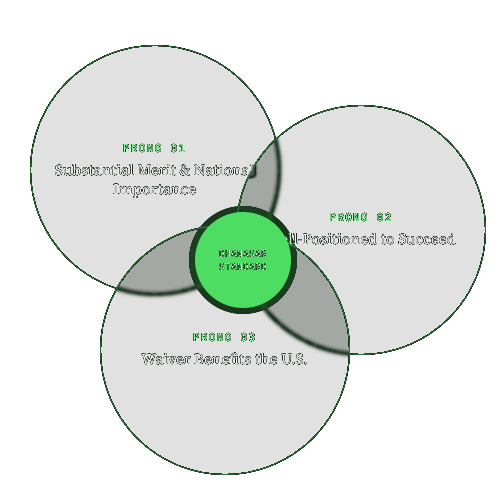
An EB-2 NIW petition asks USCIS to waive the usual job offer and labor certification requirements because your work serves the national interest. Since Matter of Dhanasar (2016), every case is judged against three prongs: substantial merit and national importance, whether the petitioner is well-positioned to succeed, and whether waiving the standard requirements benefits the U.S. on balance. For entrepreneurs, a business plan is the one document built to answer all three.

The first prong needs real market data and a clear problem statement, not just a claim that your industry matters. The second connects your background and team to a realistic operational strategy, showing you’re the right person to execute, not just that the idea is sound. The third relies on job creation, wages, and tax impact to argue that waiving the standard process serves the country more than requiring it would.

The strongest plans treat these as one connected argument rather than three separate sections, market research supports the financial projections, and your qualifications make those projections credible. That’s why a plan drafted specifically for USCIS, not adapted from an investor pitch, tends to move through review with far fewer Requests for Evidence.


What's inside your blueprint

Recent Business Plans Crafted by Our Experts

Our experts have crafted detailed business plans for a variety of industries, including those listed below. These are just some of our most recent projects, and we have successfully supported many more businesses in the past. With deep industry knowledge and experience, we create custom solutions to help businesses navigate their growth and immigration needs.

It's not required. It's what wins the case anyway!

USCIS never mandates a business plan for entrepreneur-led NIW petitions — but adjudicators consistently rely on one to decide whether your venture actually meets the legal standard. Here’s the evidentiary weight it carries.

Proves substantial merit & national importance

Market research, industry growth data, and economic impact figures show your venture matters at a national scale — not just to you

Establishes you as "well-positioned"

Your background, strategy, and competitive advantage, laid out clearly enough that an officer can connect your résumé to your results.

Documents job creation & economic benefit

Hiring projections, wage estimates, and growth timelines are the strongest single argument for waiving the labor certification.

Strengthens the waiver argument

A credible plan makes the case that skipping a job offer and labor certification is itself in the national interest.

Gives officers a decision they can defend

The more data-driven and specific the plan, the easier it is for USCIS to approve — and to justify that approval on paper.

Replaces a template with a narrative

Adjudicators read hundreds of filings. A plan that tells a clear, specific story is what makes yours memorable — for the right reasons.

From first call to finished plan

Step 1 - Contact & Agreement

Email or use the contact form to share your details, then we’ll then finalize the contract and send the invoice.

Step 2 - Information & Plan Creation

Complete a guided questionnaire. Your dedicated writer drafts a custom plan, typically within 7–10 business days (rush available).

Step 3 - Review & Finalization

Send feedback to you and your attorney. We refine the content and hand off a polished, submission-ready design.

Built for USCIS, written for your case

– Why founders choose immivox

01. No cookie-cutter plans

Every EB-2 NIW case is unique. Templated plans raise suspicion — ours are built from your questionnaire, not a boilerplate.

2. Fewer RFEs, fewer revisions

Well-researched, properly formatted plans on the first pass — reducing the back-and-forth that slows down your filing.

3. Clear, officer-ready presentation

Your vision, market opportunity, and job-creation potential, written so a non-specialist adjudicator can follow it in one read.

4. 100+ industries, one team

From SaaS to healthcare consulting, our writers pair immigration knowledge with real sector research.

GET IN TOUCH WITH US!

Please enable JavaScript in your browser to complete this form.
Click or drag files to this area to upload. You can upload up to 5 files.

Frequently Asked Questions

Unlock Answers: Your Complete Guide to our Business Plans

Explore our FAQ section for answers to commonly asked questions about our services. If you can’t find the information you’re looking for, don’t worry! Simply click the button below to submit your query, and our team will promptly assist you with the information you need. Your satisfaction is our priority, and we’re here to make sure you have all the details required.

No — USCIS does not explicitly require one. But for entrepreneurs, it's the clearest way to satisfy all three prongs of the Dhanasar standard in a single, cohesive document, which is why most successful self-petitions include one.

Most plans are delivered in 7–10 business days depending on the complexity of your venture and industry. A rush service is available if you're working against a premium processing or priority date deadline.

Yes. Even pre-revenue ventures need a 3–5 year financial forecast — projected income, expenses, and hiring — to demonstrate feasibility and job creation potential to USCIS.

We recommend focusing on a single, well-defined endeavor. USCIS wants a realistic, specific plan for the exact venture you intend to advance — not a portfolio of possibilities.

Yes. Plans are formatted as filing-ready exhibits and written to align with the legal arguments your attorney is already building around the three-prong test.

That's fine. We regularly build plans for founders who are still pre-formation — the plan itself can be part of the evidence supporting your intent and readiness to launch.